TedLipien.com, Truckee, CA, February 08, 2011 — One would think that the centennial of Ronald Reagan’s birthday could be a perfect public diplomacy theme for all U.S. embassies in Central and Eastern Europe — a great opportunity for embassy-sponsored events to strengthen ties with America among diverse nations that owe their current independence and freedom in large part to President Reagan’s vision combined with his steadfastness in standing up to the “Evil Empire.” And yet, both highly-trained and highly-paid U.S. diplomats working in the countries of the former Soviet Block by and large completely ignored the anniversary of Ronald Reagan’s birthday. Only two diplomatic post out of more than a dozen in the region sponsored a public event designed to remind older and younger generations of East Europeans of Ronald Reagan’s contribution to freeing them from Soviet domination. Read more…
All posts tagged Lee A. Feinstein
Reagan is Out, Obama is In – U.S. Embassies in Central and Eastern Europe Ignore 100 Anniversary of Ronald Reagan’s Birthday
Leaked U.S. Embassy Warsaw Cables – Obama to the Poles: Have some Patriot missiles that don’t work to protect you from Russia
Obama to the Poles: Have some Patriot missiles that don’t work to protect you from Russia
Opinia.US Truckee, CA, December 6, 2010 — The Guardian newspaper in the U.K. has released and commented on a number of leaked U.S. cables dealing with Poland. There needs to be a much greater scrutiny of these cables by mainstream U.S. media and political pressure from Polonia voters to force President Obama to change his course on Poland. Read more…
Obama Plays Golf After Skipping Polish President’s Funeral
Obama’s Public Diplomacy Katabasis in Poland
President Obama may very well kiss the Polish American vote good bye after committing yet another public diplomacy blunder which gave Vice President Biden, U.S. Ambassador to Poland Lee A. Feinstein and some Congressional Democrats plenty of reasons to be pulling their hair out in utter frustration over his insensitive behavior toward an important U.S. ally.
Biden and Feinstein, who have a much greater appreciation of history and diplomatic protocol than the President, had pushed hard to get him to agree to attend Polish President Lech Kaczynski’s state funeral in Krakow last Sunday. They briefly succeeded in their efforts but then the cloud of ash from the Icelandic volcano disrupted international air travel in Europe. Obama may have had a reasonable explanation for cancelling his plane trip due to the ash cloud in the atmosphere. But in a display of unheard of diplomatic insensitivity, he allowed himself to be photographed playing golf on the same day as the Polish President’s body was being buried at the Wawel Castle in Krakow.
By his actions last Sunday, Obama created a public diplomacy disaster for America in Poland and among the Polish American electorate. Meanwhile, Russia’s President Dmitry Medvedev, who had flown by plane from Moscow to attend the funeral, showed that he and Prime Minister Vladimir Putin can be real masters in shaping public opinion in a situation that could have had very bad repercussions for Russia and Russian-Polish relations. If anything, the death of President Kaczynski and other Polish leaders in Russia in the plane crash near Katyn, the place where Stalin’s secret police murdered thousands of Polish military officers during World War II, led to the strengthening of Polish-Russian ties due to outstanding public relations moves by both Putin and Medvedev.
This was not the first U.S. public diplomacy blunder vis-a-vis Poland since the Obama administration took office. Last September, President Obama deprived Poland of the U.S. missile defense system which the Polish government saw as the only effective military guarantee of America’s commitment to defend their country’s sovereignty against threats from Russia’s autocratic leaders. Obama announced his decision on September 17, the anniversary of Poland’s invasion by the Soviet Union in 1939 under the terms of Stalin’s secret agreement with Hitler which led to the division of the country between the two dictators.
It’s likely that the timing of the White House missile shield announcement was influenced by clever diplomatic suggestions from the Russian Foreign Ministry. Obama’s goal was to get Moscow to help him in dealing with Iran — help which he has not received and is not likely to get — and to sign the new arms control agreement with the Kremlin.
The arms agreement was indeed signed recently by President Obama and President Medvedev in Prague, the Czech Republic. But from the public diplomacy perspective, it was a very curious choice of a location for the U.S.-Russian arms control summit. By bringing the two leaders to Prague, the Russians managed to send a subtle signal, and perhaps a warning, to East and Central Europeans that the United States does not have a very long historical memory about the Soviet-led invasion of Czechoslovakia in 1968. The subtle message from the Kremlin was that just as it happened at the end of World War II, Russia and the U.S. can always find common ground at the expense of the defense and security needs of Eastern and Central Europe.
Many Poles interpret Obama’s actions as a further proof that he knows little about Poland’s history and even less about public diplomacy. While French President Sarkozy and German Chancellor Merkel also cancelled their plane trips to Poland, they did not participate in any public entertainment or sports events on the day of President Kaczynski’s funeral.
Assuming there were good safety reason for not making a plane trip to Poland, there were other options available to President Obama. He could have attended a special memorial mass at a Polish American church or visited the Polish Embassy in Washington. He did not, and one wonders whether public diplomacy experts at the White House, the State Department or the U.S. Embassy in Warsaw have made any recommendations. Even if the President of the United States lacks the necessary knowledge of history and diplomacy because of the poor level of education in American schools, there should have been at least one highly paid U.S. government bureaucrat to issue a warning to the President or his White House staff. Perhaps someone did and was ignored. We simply don’t know at this point. President Bush, who like Obama had also received poor education in world history, at least knew — or perhaps someone on his staff had told him — that it would not be a good idea after 9/11 to play golf while American soldiers are being killed in Iraq and Afghanistan.
The terrible political and diplomatic damage from Obama’s insensitivity toward Poland, Israel and other U.S. allies has been done and cannot be easily reversed. When President Franklin Delano Roosevelt betrayed Poland during World War II, just before the 1944 presidential elections he had himself photographed with Polish American leaders in front of the map of Poland showing the country’s eastern frontier lands which he had already secretly promised to Stalin in exchange for the Soviet dictator’s vague promise to help with the war with Japan — the help that Stalin could not and would not give if it did not serve his own interests and that was not needed.
It’s doubtful that the Polish Americans can be fooled again, especially since the Obama White House and President Obama himself lack FDR’s sophistication in manipulating public opinion, although they certainly share his naive trust in Russia’s autocratic leaders. In fact, Obama is being manipulated by Putin and Medvedev. They are far more clever and sophisticated than the U.S. President when it comes to the knowledge and political use of history, public diplomacy and public opinion. The late President Kaczynski understood President Obama’s weak grasp of history. Shortly after the White House announced its decision to pull the missile defense system from Poland, the Polish President sat next to President Barack Obama at a luncheon in New York where world leaders were gathered for the UN session of the General Assembly. During his meeting with Barack Obama, President Kaczynski gave him a copy of Alex Storozynski’s book about Tadeusz Kosciuszko: The Peasant Prince: Thaddeus Kosciuszko and the Age of Revolution, Polish Press Agency reported. President Obama’s copy of The Peasant Prince had an inscription from the author which said: “To President Obama, May Kosciuszko inspire you to learn more about Poland, the country whose motto is, For Your Freedom and Ours.”
As a result of the Kremlin’s brilliant public relations strategy and Obama’s failure to grasp the importance of historical symbolism, Poland and Russia may develop closer ties while U.S.-Polish relations will weaken. While there is nothing wrong with Poland and Russia getting along better, Poland should not be forced to make painful and unnecessary compromises with the Kremlin simply because the U.S. has a president with a naive worldview reminiscent of Franklin Roosevelt’s assessment of Stalin.
See the link below how the Polish media has reacted to President Obama’s faux pas.
Warsaw Business Journal – Online Portal – wbj.pl.
Further comment from TedLipien.com:
Polish media was upset not so much by Obama’s decision not to fly to Poland for President Kaczynski’s funeral as by his choice of using free time Sunday, the day of the funeral, to play golf. This was yet another public diplomacy disaster for Obama in Poland. Russia’s President Medvedev flew by plane to Poland to attend the funeral. Last year President Obama announced his decision to remove the planned U.S. missile defense system in Poland on the anniversary of the 1939 Soviet invasion of Poland.
Obama diplomacy lost in confusion

TedLipien.com, SAN FRANCISCO — Speaking softly to dictators while insulting faithful allies seems to be the essence of President Obama’s confused diplomacy.
The Obama administration has repeatedly offended Poland’s pride in recent months, making Polish officials extremely suspicious and anxious about foreign policy and military commitments of the new U.S. administration. First, President Obama made public his strong desire to “reset” relations with Moscow, based apparently on a naive assumption that Russian leaders would help him deal with nuclear Iran, as if helping the U.S. could ever advance their own authoritarian ambitions. He later declined the Polish government’s invitation to attend the 70th anniversary commemoration of the outbreak of World War II, which was held in Gdansk, the birthplace of Solidarnosc, on September 1, a date of great historical importance to the Poles. Russian Prime Minister Vladimir Putin was there along with other foreign dignitaries.
This American diplomatic snub, combined with the fact that the White House and the State Department were silent during the summer, as various Russian government officials and Kremlin supporters defended Stalin and his pre-World War II pact with Hitler, did not escape the attention of Polish leaders and the Polish public. The Hitler-Stalin pact resulted in Poland’s partition by Nazi Germany and the Soviet Union, with the Soviet attack launched on September 17, 1939.
The final blow came when President Obama made his decision to cancel U.S. plans to build the anti-ballistic missile system in Poland and the Czech Republic, and chose to announce it on the very day the Poles were commemorating the tragic anniversary of the Soviet invasion of their country. Countless public diplomacy experts in the White House and the State Department, including President Obama’s future ambassador to Poland, did nothing to prevent this completely avoidable insult. Wired headline said it all: Dear Poland, Happy Soviet Invasion Day. Love Uncle Sam.
Alarmed by naive foreign policy statements coming from Washington, Lech Walesa, Vaclav Havel and other Central European leaders had sent a letter to President Obama in July 2009, warning him of the Kremlin’s aggressive behavior toward Russia’s neighbors. The mishandling of the ballistic missile defense (BMD) issue and subsequent events have shown that their alarm was justified, but their warnings have been ignored.
Finally, after an outcry of media criticism following the September 17 missile shield cancellation announcement, the White House hastily dispatched Vice President Joe Biden on a face-saving mission to Central Europe. While visiting Poland, Romania and the Czech Republic, Mr. Biden praised the courage of pro-democracy demonstrators who toppled communist regimes in 1989 while facing tanks and occasional gunfire.
But these Central Europeans, who easily saw through communist propaganda and like to match actions with words, could not fail to notice that only a few days earlier Mr. Biden’s boss had refused to meet in Washington with the revered Tibetan spiritual leader, the Dalai Lama. This was apparently out of fear of offending the aging Chinese communist leaders, who were not brandishing guns but merely frowning at him thousands of miles away from the White House. U.S. NATO allies in Central Europe also learned from news reports that, citing scheduling conflicts, President Obama had canceled his plans to attend the 20th anniversary observances in Germany of the fall of the Berlin Wall in 1989. Secretary of State Hillary Clinton will represent the U.S. Hoping to score a public diplomacy coup, Russia’s President Dmitri Medvedev later announced that he would attend along with French President Nicolas Sarkozy, British Prime Minister Gordon Brown and a score of other heads of state.
Mr. Obama is too busy to go to Berlin to honor those who fought against communism in Eastern and Central Europe. The White House did say that he would meet the Dalai Lama, but only after his official presidential visit to China. Reacting to this news, former Czech president and human rights activist Vaclav Havel sadly observed that “these minor compromises start the big and dangerous ones.”
Repeated diplomatic blunders of the Obama administration embolden dictators who now see the U.S. president as a weak and ineffective leader. They are likely to act upon this perception by further restricting human rights and press freedoms in their countries, while also threatening their smaller neighbors. This is bad news for America and the spirit of freedom that sustained the 1989 peaceful overthrow of communism in Eastern Europe.
The White House would like everyone to believe that bad translators and hostile media are misinterpreting President Obama’s foreign policy initiatives. The State Department recently blamed a Polish translator for undiplomatic remarks by President Obama’s new ambassador in Warsaw, Lee A. Feinstein, who hinted in a television interview that Poland plans to increase its engagement in Afghanistan.
While the hint was believed to be accurate, Polish government officials were furious that it was made public before foreign minister Sikorski’s scheduled visit to Washington. They did not want the Polish public to learn about it from the U.S. ambassador while sensitive negotiations were still being conducted. To make things worse, Secretary of State Hillary Clinton cancelled her meeting with Sikorski when she decided to extend her trip to the Middle East.
The latest diplomatic crises with Poland show a new level of incompetence as well as arrogance of the new Obama administration foreign policy team. The real problem with Obama diplomacy are not bad translators and journalists, but naive assumptions, surprising arrogance and dangerous incompetence. The world needs a U.S. president whose diplomacy is not lost in confusion.
Ted Lipien was in charge of Voice of America radio broadcasts to Poland during the Solidarity movement’s successful struggle for democracy. He now runs a media freedom nonprofit in San Francisco, CA.
Obama diplomacy lost in translation

TedLipien.com, SAN FRANCISCO — In angry late-night phone calls to reporters last week, State Department diplomats were defending careless comments by President Obama’s new ambassador in Warsaw, Lee A. Feinstein, who revealed on Polish TV the content of sensitive negotiations with the U.S. about increasing the number of Polish troops in Afghanistan. Polish officials had good reasons to keep this information confidential and were understandably angry.
The war in Afghanistan is not popular with the Polish people, and neither is the idea of committing more Polish troops to help President Obama who removed the U.S. missile shield from Poland on the anniversary of the invasion of the country by the Soviet Union in 1939. He had earlier declined the Polish government’s invitation to participate in the 70th anniversary observances of the start of World War II. And Secretary of State Clinton cancelled her scheduled meeting in Washington this week with visiting Polish foreign minister Radoslaw Sikorski, when she unexpectedly extended her visit to the Middle East. He was going to discuss with her, among other things, Poland’s contribution to the war on terror in Afghanistan.
As to the earlier diplomatic scandal, State Department and U.S. Embassy officials tried to place fault with a Polish translator who admittedly used two extraneous words while interpreting the ambassador’s controversial remarks during a television interview. The interpreter added the words, “soldiers” and “Polish contingent,” when translating Ambassador Feinstein’s answer, in which he praised the Polish prime minister’s and president’s “commitment to being in Afghanistan, and,” he added, “actually to enhance its presence in Afghanistan.”
In a strong and angry reaction to this undiplomatically revealing answer, Polish Defense Minister Bogdan Klich said that “the ambassador committed a blunder.” “Neither the prime minister, nor the minister of foreign affairs, nor the minister of national defense,” said Mr. Klich, “made any declarations to the American side about an increase in the contingent.”
It was obvious that the U.S. envoy was implying some kind of a military commitment. While the translator made a minor error, the translation did not distort the ambassador’s essential message. The English-language Krakow Post and other Polish media outlets analyzed the transcript and came to the same conclusion.
Lee A. Feinstein’s public remarks deeply embarrassed Polish government leaders, who in an attempt to help their country’s declining standing with the Obama administration may have made vague promises to Vice President Joe Biden during his recent visit to Warsaw about increasing their military engagement in Afghanistan. But under no circumstances they wanted the Polish public to hear about it first from the U.S. envoy at a time when most Poles feel that President Obama ignores and does not understand their country.
Even the U.S. Embassy in Warsaw admitted in a news item posted on its official website prior to Ambassador Feinstein’s arrival in Warsaw, and still available online, that deep disappointment in Mr. Obama is a common sentiment shared by the Poles. Yet despite the insults, Poland was planning to send a few hundred extra soldiers to Afghanistan. The Polish leaders know that their strategic military alliance with the United States and Poland’s friendship with the American people must be kept strong regardless of who occupies the White House at the moment.
U.S. Embassy blames diplomatic gaffe on a Polish translator but a problem runs much deeper

TedLipien.com, SAN FRANCISCO — Bill Clinton might have asked what the “enhanced” definition of ”to enhance” IS? The U.S. Embassy in Warsaw is busy blaming a Polish translator for mistranslating U.S. Ambassador Lee Feinstein’s TV interview answer about Polish troops in Afghanistan, which caused a diplomatic uproar in Poland. In an interview broadcast last Saturday, Ambassador Feinstein thanked Polish prime minister and president for their “commitment to being in Afghanistan, and actually to enhance its [sic] presence,” only to be chastised two days later by the Polish defense minister for making a claim that the Polish government had not agreed to.
Most Polish media interpreted Ambassador Feinstein’s comments as revealing that Polish leaders may have told U.S. officials, specifically Vice President Biden, that Poland would increase the number of its soldiers in Afghanistan. Such secret commitments, if they were indeed expressed, would not be at all well received by the Polish public opinion. This might explain the strong reaction of Polish government officials to Ambassador Feinstein’s public comments, which most experts would view as ill-advised and undiplomatic in the current political climate in Poland, no matter how they were translated.
The presence of Polish troops in Afghanistan is a delicate issue in Poland, where support for keeping them is steadily declining. To compound this problem, Polish-American relations took a major turn for the worse after President Obama did not show up for the 70th anniversary observances in Poland of the outbreak of World War II and later canceled the Bush Administration’s missile defense plans on September 17, the day when the Poles were commemorating the 70th anniversary of the Soviet invasion of their country.
These decisions by the U.S. president were seen as a major affront to the historically-minded Poles. They are also upset over the need to secure visas to visit the United States, a policy that continues from previous U.S. administrations, but the main reason for the growing opposition to keeping Polish troops in Afghanistan is a realization that the U.S. has seriously mishandled the war.
Reacting to Ambassador Feinstein’s remarks, which clearly indicated that the Polish government was committed to staying in Afghanistan and possibly planning “ to enhance its presence,” Polish Defense Minister Bogdan Klich said that “the ambassador committed a blunder, since neither the prime minister, nor the minister of foreign affairs, nor the minister of national defense made any declarations to the American side about an increase in the contingent.” But, please remember that these are the ambassador’s first days at a new post,” Polish Defense Minister Klich added.
The English-language newspaper Krakow Post ran an online headline “U.S. Ambassador to Poland ‘Committed a Blunder’.” Polish media reported extensively on Ambassador Feinstein’s and Minister Klich’s comments, although surprisingly this story has received very little attention in the U.S. media, possibly because of the confusion of what it really means for the continued presence of Polish troops in Afghanistan. The Washington Times reported that the State Department spokesman Ian Kelly on Tuesday night attributed the controversy to an incorrect translation Saturday made on Polish television station TVN24. Ambassador Lee A. Feinstein, speaking in English, actually said that Polish officials planned to “enhance their presence” in Afghanistan and not send additional troops, Mr. Kelly said. As someone who has done thousands of translations from English to Polish, I can honestly say that the mistranslation was minimal and did not distort what Ambassador Feinstein really meant. Had it truly been a serious mistranslation, the embassy would have posted a correct translation on its website. It did not because it would show that Polish media reports about the essential meaning of the ambassador’s remarks were generally correct.
Blaming a translator is in this case a very ungracious way of trying to compensate for the ambassador’s diplomatic mistake. Other ambassadors might have received a rebuke from the Secretary of State for embarrassing their host government, but Ambassador Feinstein is very well connected within the Obama administration. His defense by the State Department adds to a series of offending statements and actions taken in recent months in Washington vis-a-vis Poland and shows a level of arrogance that was not seen even during the Bush administration, which was not known for being overly diplomatic in dealing with other countries.
Despite all the insults, it does not appear that Poland will withdraw its troops from Afghanistan. In fact, while being snubbed and embarrassed by the Obama Administration, Poland is planning to send to Afghanistan additional 200 soldiers as an emergency reserve contingent. The Polish leaders understand that regardless of who is currently occupying the White House, to protect its independence Poland must have good relations with the United States.
Taking a lead from the State Department and Ambassador Feinstein, who is now in Washington for consultations prior to Polish Foreign Minister Radek Sikorski’s visit, U.S. diplomats in Warsaw are now engaged in a counterproductive effort of trying to put the blame for a diplomatic faux pas on Polish media and the Polish translator, instead of admitting a mistake and moving on. Contrary to common sense and the often stated desire of the Obama Administration to see more Polish troops in Afghanistan, these public diplomacy ”experts” are suggesting to their media contacts that Ambassador Feinstein’s words ” prime minister’s and president’s commitment” and ”to enhance its presence” did not mean that he was talking about sending more Polish troops to Afghanistan. In an attempt to rescue the reputation of the new U.S. ambassador, they have painted themselves into a corner by implying that President Obama’s representative in Warsaw does not know what the president and the United States want Poland to do.
This is only the latest in a series of the public diplomacy disasters in Poland created by the Obama White House and the State Department. The U.S. Embassy’s lame attempts to salvage the reputation of a novice American ambassador, who apparently did nothing to prevent the September 17 missile defense announcement, actually made the controversy worse by exposing a certain lack of sincerity on the part of the Obama administration.
Ambassador Feinstein’s nomination to be Ambassador to Poland was not yet confirmed by the U.S. Senate on September 17, but as an advisor to Hillary Clinton during her presidential campaign and later to the Obama White House, he had excellent contacts that could have helped him to prevent the embarrassment of having the president announce the missile shield decision on the worst possible day for Poland.
Ultimately, however, the public diplomacy disaster ironically worked to the advantage of Central Europe. Stung by media criticism, the White House had to send Vice President Biden on a face-saving mission to Poland, Romania, and the Czech Republic, where he made a number of statements committing the U.S. to the defence of the region, which President Obama will now find difficult to ignore in his drive to “reset” relations with Moscow.
Still, the Poles, most of whom had grown up being exposed to communist propaganda and are quite cynical about exaggerated declarations from government officials, had a good reason to be sceptical when Vice President Biden insisted in Romania that President Obama’sdecision to cancel the missile defense system in Central Europe had nothing to do with Russia and was not meant to appease the Kremlin. Central Europeans who have experienced life under communism like to match words with actions.
During his trip, Mr. Biden was also effusive in his praise of the courage of Central and East European freedom fighters who had faced tanks and the threat of death or arrests as they were bringing about the fall of communist dictatorships 20 years ago. Yet today’s Central Europeans knew from news reports, that a few days earlier merely a threat of displeasing aging Chinese communist leaders thousands of miles away in Beijing persuaded President Obama not to meet in Washington with the highly-respected Tibetan spiritual leader, the Dalai Lama. Some also knew that President Obama had canceled his plans to participate in the ceremony to mark the 20th anniversary of the fall of the Berlin Wall.
These additional public diplomacy blunders deepened a major crisis of confidence in the Obama Administration among the Poles and other Central Europeans, which Vice President Biden’s high declarations were not able to erase. Overall, however, his trip to Central Europe was helpful, as the former Bush-era ambassador to Poland Victor Ashe told a New York Times reporter. My own observation is that, if nothing else, Biden’s exaggerated statements have bound President Obama to a more cautious approach toward his rapprochement with the Kremlin.
In handling, or more accurately, mishandling the controversy over Ambassador Feinstein’s remarks, the State Department diplomats could have learned from what a Polish dissident writer said when he was living in Poland under communism. When you find yourself in a difficult situation and don’t know what to say, tell the truth. They should also pay attention to what former Czech dissident, human rights activist, statesman, playwright, and Nobel Prize winner Vaclav Havel said after learning that President Obama had refused to meet the Dalai Lama.
The State Department and U.S. diplomats in Warsaw want journalists to believe that Ambassador Feinstein was not talking about more Polish soldiers in Afghanistan. What else could he have meant when he talked about “enhancing” Poland’s presence in the Afghan war zone? Polish experts on crop rotation?
The following is the Polish-language corrected transcript of the TVN24 interview with U.S. Ambassador to Poland Lee A. Feinstein. You may also follow this link to view a video of the interview, in which the relevant comments in English can still be partly heard in between the voice of the translator.
Maciej Wierzyński (in the early 1990s, Mr. Wierzyński was director of the Voice of America (VOA) Polish Service in Washington, D.C. VOA no longer broadcasts radio programs to Poland or has any other news content in Polish, neither does the State Department nor Radio Free Europe Radio Liberty, RFE/RL) : Skoro mowa o Afganistanie, z pewnością wie Pan, że w Polsce poparcie dla obecności polskich wojsk Afganistanie słabnie. Niektórzy politycy otwarcie wzywają do wycofania polskich wojsk. Jak pan odpowiedziałby na takie obawy.
Lee A. Feinstein: To świetne pytanie, tak naprawdę to jest problem nie tylko w Polsce ale i w Stanach zjednoczonych. W Stanach poparcie społeczne dla narażania ludzi na niebezpieczeństwo to zawsze delikatna kwestia. Chcę więc powiedzieć o tym kilka rzeczy. Po pierwsze – Stany Zjednoczone są zdecydowane zostać w Afganistanie i co do tego nie powinno być żadnych wątpliwości. Prezydent, jak Pan zapewne wie, rozważa różne opcje w Afganistanie – dokładniej jak iść z misją do przodu. Jedna rzecz jest poza dyskusją – wycofanie. Prezydent jest zdecydowany zostać w Afganistanie i zwyciężyć. Mam nadzieję, że to daje trochę pewności, oczywiście to ciężka walka, jesteśmy wdzięczni polskiemu premierowi i prezydentowi za zobowiązanie by być w Afganistanie, w istocie, żeby wzmocnić obecność w Afganistanie. Jesteśmy niezwykle wdzięczni Polakom za wspólne poświęcenie.
More diplomatic confusion between U.S. and Poland

Opinia.US SAN FRANCISCO — U.S. media has not yet picked up on the latest diplomatic controversy between Poland and the U.S. But the public disagreement between president Obama’s new ambassador in Warsaw Lee A. Feinstein and the Polish defense minister over plans to send additional Polish troops to Afghanistan is drawing media attention in Poland.
Ambassador Feinstein made a public statement, in which thanked the Polish government for planning to enlarge its military contingent in Afghanistan, but Polish Defense Minister Bogdan Klich has denied that a decision to increase Poland’s troop deployment in Afghanistan had been taken.

On Saturday, Ambassador Feinstein said on the TVN24 Polish television channel that Poland’s president and prime minister “declared that not only would they be keeping Polish soldiers in Afghanistan, but they would also enlarge the contingent. This is something for which we are very grateful.”
Speaking Monday morning at a press conference, Bogdan Klich denied such claims and suggested that Ambassador Feinstein may have been guilty of a diplomatic faux pas. Mr. Klich said “The ambassador committed a blunder, since neither the prime minister, nor the minister of foreign affairs, nor the minister of national defense made any declarations to the American side about an increase in the contingent. But, please remember that these are the ambassador’s first days at a new post.”
Picking up on the Polish defense minister’s comments, the English-language newspaper Krakow Post ran an online headline “U.S. Ambassador to Poland ‘Committed a Blunder’.” The Polish Radio’s International Service posted on its website a report under a more diplomatic headline “Confusion over Poland’s Afghan deployment deepens.”
Polish Radio quotes Mr. Klich as saying “There is no such decision, nor plans.” The Polish defense minister added that the contingent of 2,000 Polish soldiers in the Ghazni province in Afghanistan will not be enlarged unless it is absolutely necessary. He did confirm, however, that 200 soldiers would be going to Afghanistan to be held in strategic reserve in case of emergencies.
Responding to questions about Ambassador Feinstein’s comments, President Kaczynski’s office said that no detailed plans had been sent by the defense ministry on the issue of enlarging the Polish military contingent in Afghanistan, and that it was far too early to make such a decision.
Surprisingly, U.S. media, which has been lately reporting extensively on Afghanistan, has not yet picked up on this story. It was reported by the Chinese news agency Xinhua. A brief summary of the Xinhua report was placed on The USA Today website.
Whether other U.S. media outlets report on this story will become clearer on Tuesday. An earlier diplomatic blunder between Poland and the U.S. over President Obama’s announcement about the removal of the U.S. missile defense shield system from Poland and the Czech Republic, which he made on the day of the 70th anniversary of the Soviet invasion of Poland at the beginning of WWII, received considerable U.S. media attention.
Media criticism may have forced President Obama to send Vice President Biden on a face-saving mission to Central Europe. During the visit, Mr. Biden made several strong comments in support of U.S. commitments to the defense of Poland and other Central European nations, which President Obama may now find difficult to ignore in his attempts to improve relations with Russia.
Koniec wiadomości/analizy Opinia.US. Można ją opublikować z powołaniem się na Opinia.US. End of Opinia.US report/analysis. Opinia.US reports/analyses may be republished with attribution.
Ten tekst by Opinia.US is licensed under a Creative Commons Uznanie autorstwa 3.0 Stany Zjednoczone License.
This work by Opinia.US is licensed under a Creative Commons Attribution 3.0 United States License.
Subscribe to TedLipien.com
Sourced from: Opinia.US
Kryzys dla nowego ambasadora USA

Opinia.US SAN FRANCISCO — Lee A. Feinstein, nowy ambasador Stanów Zjednoczonych w Polsce, przybył do Warszawy 13 października. Rozpoczyna on pracę w atmosferze poważnego kryzysu, wywołanego decyzją Prezydenta Obamy o wycofaniu z Polski antyrakietowej tarczy obronnej. Obawy i podejrzenia w Warszawie znacznie pogłębiło dyplomatyczne fiasko ogłoszenia decyzji 17 września, w 70-tą rocznicę inwazji ZSSR na Polskę.
Brak wystarczających konsultacji i wykonywane w środku nocy telefony Prezydenta Obamy do przywódców środkowoeuropejskich można uznać za dodatkowy dowód, że był to jednen z najbardziej niefortunnych błędów dyplomacji amerykańskiej w ostatnich latach.
Ambasador Feinstein ma przed sobą niełatwe zadanie naprawy stosunków polsko-amerykańskich. Jeszcze przed jego przyjazdem do Polski, w geście bezprecendensowej śmiałości jak na amerykańską placówkę dyplomatyczną, Ambasada Stanów Zjednoczonych w Warszawie przyznała w wiadomości opublikowanej po angielsku i po polsku na swej oficjalnej stronie internetowej, że zdaniem Polaków wybór “tak niezręcznej pory” — jak to określiła ambasada — na ogłoszenie decyzji Białego Domu o zmianie podjętego przez prezydenta Busha planu budowy tarczy antyrakietowej w Polsce świadczy o tym, że “Obama nie rozumie Polski.” Read more…
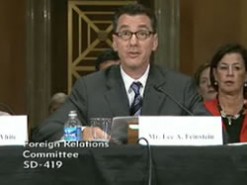
Lee A. Feinstein Senate Video
Ambassador Feinstein was nominated by President Obama on July 20, 2009 and was confirmed by unanimous consent by the U.S. Senate on September 22, 2009. As it came just two days before President Obama’s controversial announcement on removing the American missile shield from Poland, his confirmation hearing before the U.S. Senate Foreign Relations Committee on September 15, 2009 did not include any pointed questions from either Republicans or Democrats. He was sworn in on September 28, 2009. The video of his testimony can also be accessed here. The text of his Senate testimony can be accessed here.
Had he been scheduled to appear before the committee after September 17, he would have presumably faced tough questions, at least from Republican senators. As it was, his confirmation hearing was merely a formality. Ambassador Fenistein’s statement comes toward the middle of the video.
Sourced from: Opinia.US
New U.S. Ambassador in Poland Faces Crisis

Opinia.US SAN FRANCISCO — Lee A. Feinstein, the new U.S. Ambassador to Poland, arrived in Warsaw on October 13, 2009. He faces a serious crisis in U.S.-Polish relations, precipitated by President Obama’s decision to remove the American missile shield from Poland. Warsaw’s fears and suspicions have been made far worse by the clumsy handling of the decision’s announcement on September 17, which coincided with the 70th anniversary of the Soviet invasion of Poland. Read more…
-
U.S. Taxpayers Pay for Spreading Racist Views on Radio Liberty in Russia
-
Citizen Journalists in Belarus Tell Election Story to Voice of America but VOA Fails to Deliver News Back to Belarus
-
Kremlin Can’t Pursue War Against Internet Without Hackers, Expert Says, But This Is No Consolation for Voice of America
-
Broadcasting Board of Governors Tried to Hire John Cochran for a Public Relations Job While Cutting Voice of America Radio to Russia
-
RFE/RL Has Lost Its Uniqueness Warns Former Director of Radio Liberty's Russian Service
-
CUSIB’s Ted Lipien warns against diminished public stake in U.S. international broadcasting
January 19, 2012 | Comments Off -
BBG Watch stories added to TedLipien.com
January 19, 2012 | Comments Off -
Samizdat at Radio Free Europe – Radio Liberty describes discrimination against foreigners, women and ‘old white guys’
January 5, 2012 | Comments Off -
Top China-Watcher Dr. Willy Lam supports continuing Voice of America Chinese broadcasts
January 4, 2012 | Comments Off -
BBG Watch most popular posts focus on mismanagement at Broadcasting Board of Governors
December 31, 2011 | Comments Off
| M | T | W | T | F | S | S |
|---|---|---|---|---|---|---|
| « Jan | ||||||
| 1 | 2 | 3 | 4 | 5 | ||
| 6 | 7 | 8 | 9 | 10 | 11 | 12 |
| 13 | 14 | 15 | 16 | 17 | 18 | 19 |
| 20 | 21 | 22 | 23 | 24 | 25 | 26 |
| 27 | 28 | 29 | ||||


Opinia.US
Anonymous: This is correct? How is he justifying this? To retain these employee...
Brahna: Like too many others, Mr. Lobo fell into step, following "past practic...
Anonymous: Horsecrap. Nothing says SES members have to get bonuses. Anyone earn...
VOA contractor: I am very happy to see the POV director at VOA has posted a survey lin...
Anonymous1: You're right. it is truly extraordinary. Victor Ashe is a courageous...