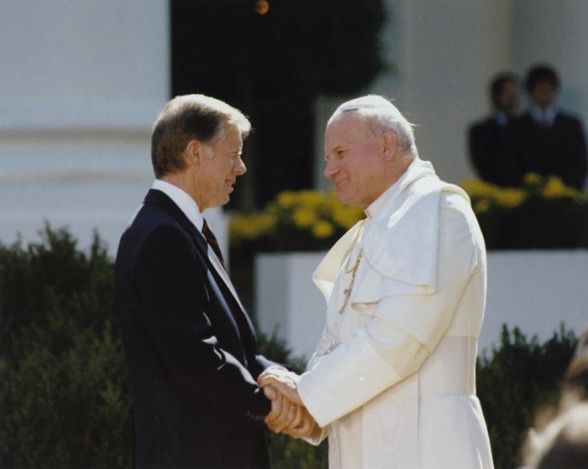
Pope John Paul II’s 1979 Visit to the U.S. – VOA Video

Jul 20, 2009 Comments Off by
President Jimmy Carter with Pope John Paul II, photograph by Bill Fitz-Patrick, October 6, 1979

President Jimmy Carter with Pope John Paul II, photograph by Bill Fitz-Patrick, October 6, 1979

Pope John Paul II’s 1979 Visit to the U.S. – VOA Video

President Jimmy Carter’s notes from his private meeting with Pope John Paul II, October 6, 1979, front
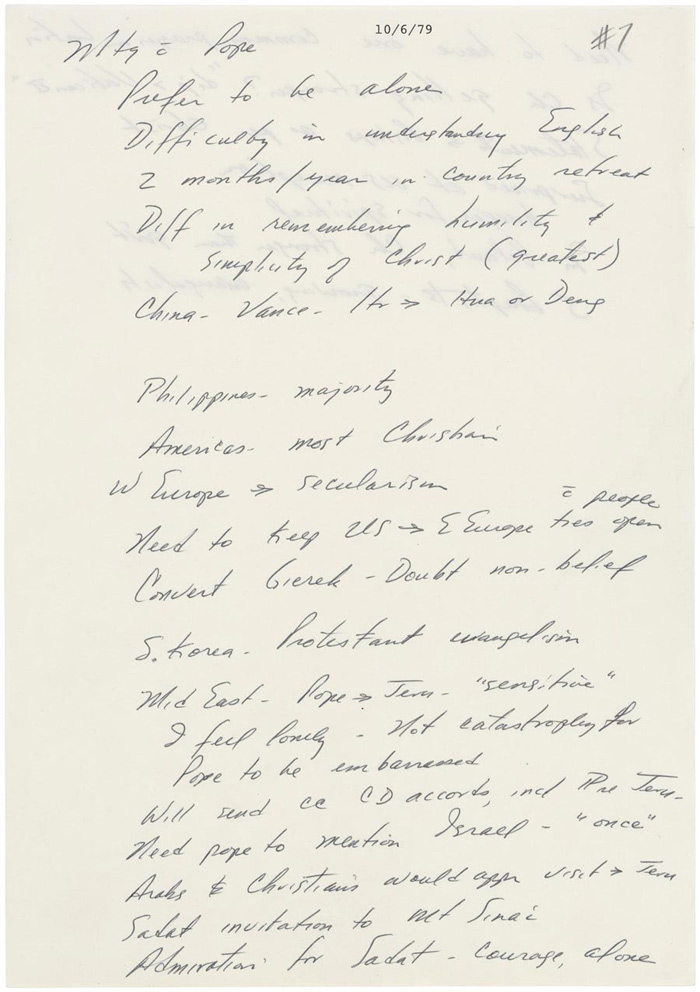
President Jimmy Carter’s notes from his private meeting with Pope John Paul II, October 6, 1979, front

Although his notes are sketchy, they show that the discussion included particular situations in the Philippines, China, Europe, South Korea, and the Middle East. The White House issued a statement that day stating that during the meeting “the Pope and the President agreed that efforts to advance human rights constitute the compelling idea of our times.”

National Archives, Jimmy Carter Presidential Library and Museum, Atlanta, Georgia

President Jimmy Carter’s notes from his private meeting with Pope John Paul II, October 6, 1979, reverse
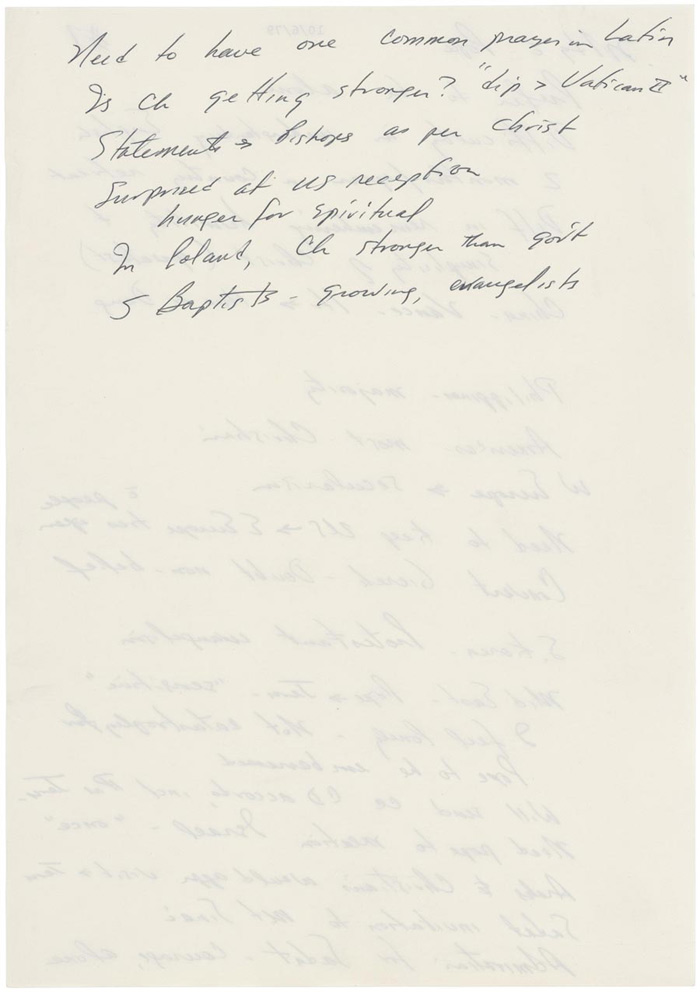
President Jimmy Carter’s notes from his private meeting with Pope John Paul II, October 6, 1979, reverse

National Archives, Jimmy Carter Presidential Library and Museum, Atlanta, Georgia

Video

About the author

Ted Lipien is a writer, journalist, and founder of the San Francisco-based media freedom nonprofit FreeMediaOnline.org. As a former Voice of America (VOA) acting associate director, he was responsible for placement of radio and TV programs on stations in Russia, Bosnia, Afghanistan, Iraq and other countries in Eurasia. In the 1980’s he was in charge of VOA radio broadcasts to Poland during the communist regime’s crackdown on the Solidarity labor union and oversaw the development of VOA television news programs to Ukraine and Russia. His book, "Wojtyla's Women: How They Shaped the Life of Pope John Paul II and Changed the Catholic Church" (O-Books, UK - June 2008), describes Pope John Paul II’s views on feminism, birth control, abortion and other gender-related issues. The book also analyzes the impact of World War II and communism on the development of Pope John Paul II religious, philosophical, and political views.
Comments are closed.